Choosing a digital marketing agency is a big decision for a UK small business. The right partner can turn your budget into a steady stream of enquiries. The wrong one can tie you into a long contract with little to show for it. This practical checklist will help you compare agencies, spot the warning signs and ask the questions that reveal how an agency really works.
1. Start with your goal, not the agency’s services list
Before you speak to anyone, write down what you want to achieve in the next six to twelve months. More enquiries? More booked appointments? Online sales? A good agency will ask about your goals, margins and capacity before recommending channels. Be wary of anyone who proposes a full package before understanding your business.
2. Understand typical UK costs
Prices vary with the number of channels and the amount of work involved. Indicative UK guides put small-business retainers at roughly £500 to £1,500 a month for a single channel, rising to £1,500 to £5,000 for mid-sized businesses, with many agencies asking for a three to six month minimum term (ExpertSure). These are ranges rather than survey data, so use them as a starting point.
Two things to check in any quote:
- Is ad spend included or separate? The agency fee and the money paid to Google or Meta should be listed separately, so you can see what each costs.
- What exactly is included? Number of channels, campaigns, creative, reporting and calls should all be written down.
3. Red flags to watch for
Google’s own guidance for businesses hiring an SEO is blunt: “No one can guarantee a #1 ranking on Google” (Google Search Central). The same page lists warning signs that apply to most marketing agencies, including:
- Claims of a special relationship with Google, or “priority submission”.
- Unsolicited emails promising page-one rankings.
- Secretive methods, or refusing to explain what they will change.
- Link schemes or other shortcuts that break search engine guidelines.
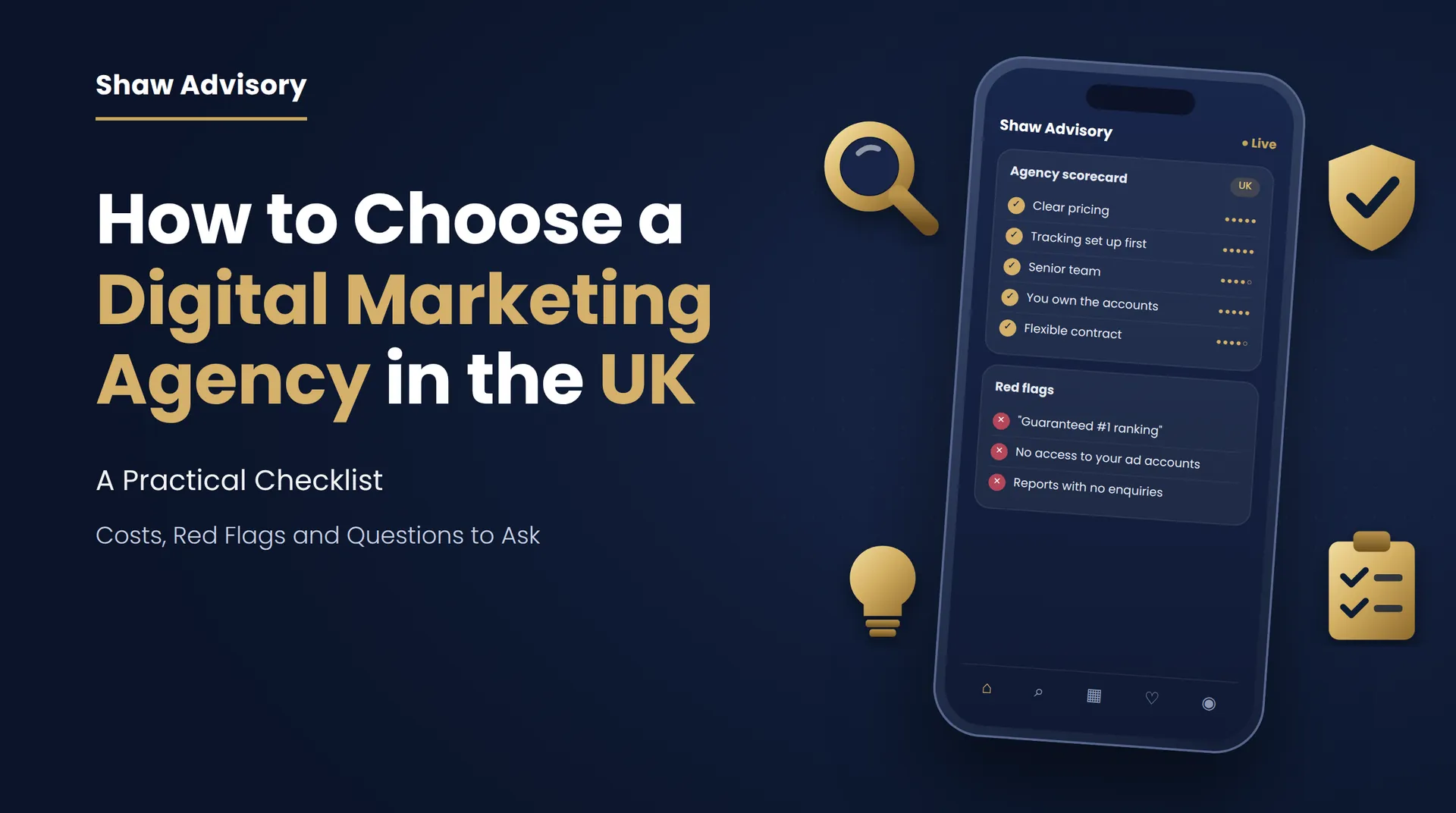
Add a few more of your own: guaranteed lead numbers, no access to your own ad accounts, and reports full of impressions and likes but no enquiries.
4. Questions to ask every agency
Google suggests asking an SEO for examples of past work, whether they follow its Search Essentials, what results and timeframe to expect, their industry experience, and how they will communicate and share changes (Google Search Central). For a full-service agency, add:
- Who will actually run my account? A senior strategist, or a junior who has just joined?
- How will you track results? Ask how enquiries, calls and sales are measured, and whether tracking is set up before any spend.
- Who owns the accounts? Your ad accounts, analytics and website should belong to you, with the agency given access.
- What does a monthly report look like? Ask to see an example, with the figures anonymised.
- What happens if I want to leave? Check the notice period and what you keep.
5. Check they understand UK rules
A UK agency should be comfortable with the rules that affect your marketing:
- Advertising standards: ads must follow the CAP Code, which requires them to be “legal, decent, honest and truthful” (ASA). This matters most in sectors such as health, beauty and finance.
- Privacy and cookies: tracking tools such as the Meta Pixel need consent, under the ICO’s guidance on storage and access technologies (ICO). Your website needs a cookie banner that lets visitors say no.
If an agency cannot explain how it handles these, that is a warning sign in itself.
6. Specialist or full-service?
A specialist agency can be a good fit if you only need one channel, such as SEO. If you need paid ads, search and your website working together, a full-service agency avoids the gaps and finger-pointing that come with several suppliers, and keeps your reporting in one place.
A simple scorecard
Score each agency from one to five on: understanding of your goals, clarity of pricing, quality of tracking, seniority of the team, reporting, contract flexibility and knowledge of UK rules. The highest total is usually a better guide than the most impressive pitch.
If you would like to see how Shaw Advisory answers these questions, book a free strategy call. Our plans are published, our contracts roll monthly after onboarding, and you always own your accounts.