If you run a small business in the UK, the first question about Facebook and Instagram advertising is usually the simplest one: how much will it cost? The honest answer is that Meta ads cost whatever you decide to spend. What you get for that money depends on your audience, your offer, your creative and the time of year. This guide explains the numbers that matter, what drives them up or down, and how to set a sensible starting budget.
How Meta ads pricing works
Meta ads run on an auction. You set a budget, and Meta charges you as your ads are shown or clicked. You never pay more than the budget you set, but the price of each result changes all the time, depending on how many other advertisers want to reach the same people. That is why it is more useful to understand typical costs than to look for a fixed price list.
The three numbers most small businesses watch are:
- CPM (cost per 1,000 impressions): what it costs to show your ad 1,000 times.
- CPC (cost per click): what you pay, on average, for each click to your website or form.
- CPL (cost per lead): what it costs to get one enquiry, such as a form fill or a message. For most service businesses, this is the number that matters.
What UK advertisers are paying in 2025–2026
Independent, published UK benchmarks for Meta ads are hard to find. One dataset comes from Superads, an advertising software company that publishes medians from the UK accounts on its platform. Treat these as a guide from one platform’s data rather than an industry standard:
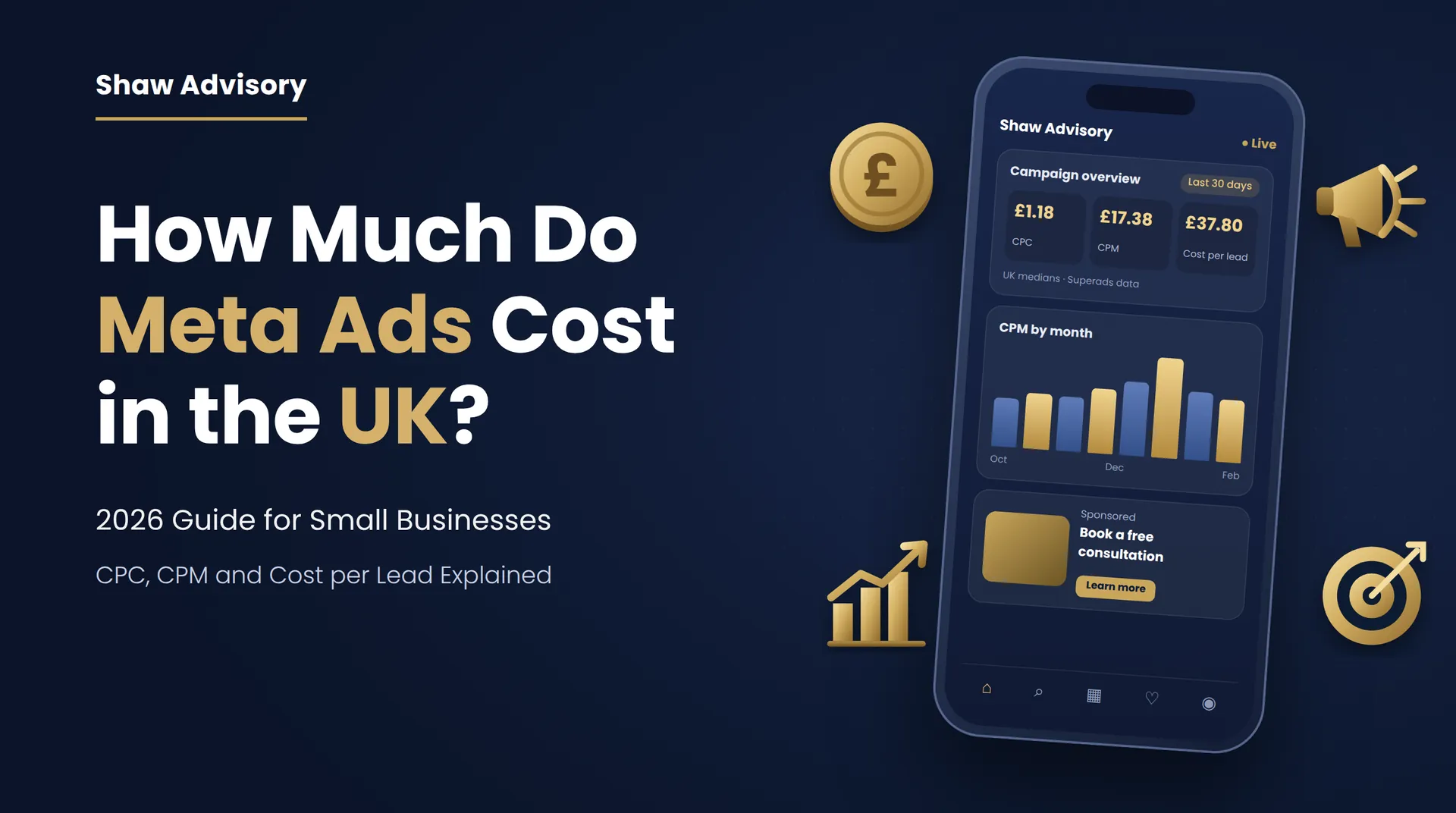
- CPC: a UK median of about £1.18 between July 2025 and July 2026, ranging from about £1.02 (October 2025) to £1.49 (December 2025). (Superads)
- CPM: a UK median of about £17.38 over the same period, from about £13.20 in October 2025 to £26.48 in December 2025. (Superads)
- Cost per lead: a UK median of about £37.80 between September 2025 and August 2026, ranging from about £17.46 to £59.71 depending on the month. (Superads)
Your own results can be well above or below these figures. A clinic promoting a high-value treatment and a local trade business chasing quote requests will see very different costs per lead, even with the same budget.
What makes Meta ads more or less expensive
1. The time of year
The biggest swing in the data above is seasonal. CPMs in December were roughly double those in October, because retailers compete hard for attention in the run-up to Christmas. If your business is not seasonal, the quieter months can be a cheaper time to test.
2. Your audience
Narrow, highly competitive audiences cost more to reach. Very small audiences also give Meta’s system less room to find the people most likely to respond. For most small businesses, a sensible location radius and broad targeting, guided by good creative, outperforms long lists of interests.
3. Your creative and offer
Ads that people stop for and engage with tend to cost less per result. A clear offer, a strong opening line or first second of video, and a simple next step do more to lower your cost per lead than almost any setting.
4. Your campaign objective
If you optimise for clicks, Meta finds people who click. If you optimise for leads, it looks for people who fill in forms. Choose the objective that matches the result you want, and make sure your tracking reports that result accurately.
5. Your tracking
Meta learns from the conversions you send back through the Pixel and the Conversions API. If tracking is missing or broken, the system optimises on poor data and your costs usually rise. Setting this up properly before spending is one of the most valuable things you can do.
How to set a starting budget
There is no official minimum that suits every business, so work backwards from what a customer is worth to you:
- Estimate your target cost per lead. If one in five enquiries becomes a customer worth £1,000 in profit, you can afford to pay well under £200 per enquiry and still grow profitably.
- Allow enough budget to learn. Meta needs a steady flow of results to optimise. A budget that only produces a handful of leads a month makes it hard to judge what is working.
- Plan a test period. Give a campaign a few weeks and several creative variations before judging it, then move budget towards what performs.
Remember that the ad budget is separate from any agency fee. At Shaw Advisory, ad spend is always paid directly to Meta, so you can see exactly where every pound goes.
Two UK rules to know before you advertise
- The CAP Code: paid social ads in the UK fall under the CAP Code, which says ads must be “legal, decent, honest and truthful” (ASA). Health and beauty businesses in particular should check their claims before launching.
- Cookie consent for the Meta Pixel: the ICO’s guidance on storage and access technologies covers tracking pixels, and consent is the central requirement when tracking is used for online advertising (ICO). A proper cookie banner is essential before the Pixel fires.
The bottom line
Meta ads can work well for UK small businesses, but the cost depends far more on your offer, creative and tracking than on any single benchmark. Start with a budget you can sustain for a proper test, measure cost per lead rather than clicks, and expect costs to rise in the final months of the year.
If you would like a second opinion on your budget or current campaigns, book a free strategy call with our team. We will look at your numbers and tell you honestly what we would change.