“How much should I spend on Google Ads?” is one of the most common questions small business owners ask. There’s no single right number, but there is a sensible way to work it out. This guide walks through current US benchmarks, how Google’s daily budgets actually work, and a simple method for setting a starting budget you can defend.
What small businesses are paying for Google Ads
Two large annual benchmark reports give a good picture of typical US search ad costs:
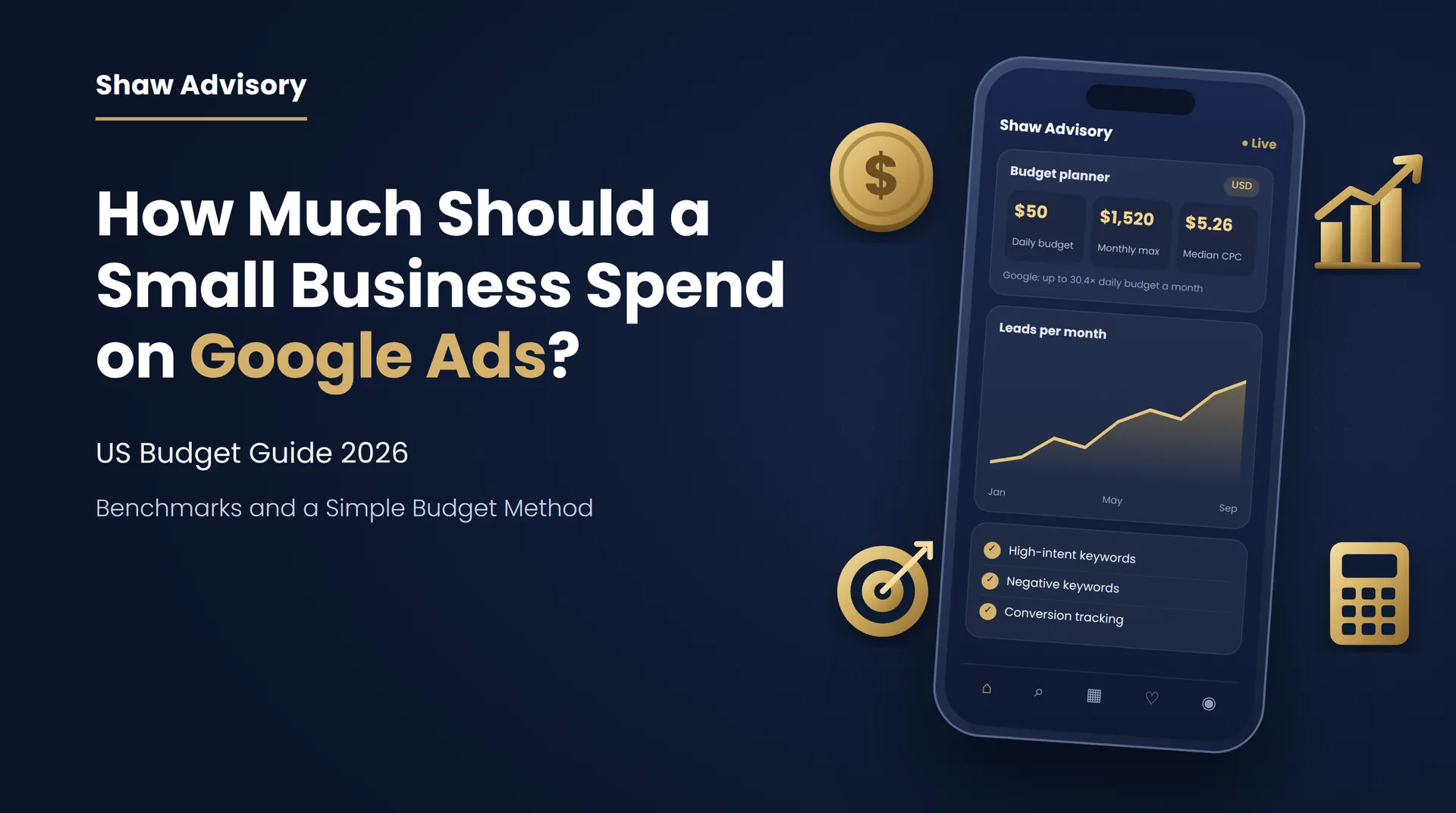
- WordStream 2025 Google Ads benchmarks: across 16,446 US search campaigns (April 2024 to March 2025), the median cost per click was $5.26, the conversion rate was 7.52% and the cost per lead was $70.11 (WordStream).
- LocaliQ 2026 search advertising benchmarks: an average cost per click of $5.42, a conversion rate of 8.18% and a cost per lead of $66.69, with LocaliQ noting that cost per lead fell for the first time in five years (LocaliQ).
Costs vary a lot by industry. In WordStream’s data, for example, legal services had a median cost per lead of $131.63, dental $83.93 and real estate $100.48 (WordStream). Use these as a reference point, not a promise: your location, competition and landing page all move the numbers.
How much of your revenue should go to marketing?
You’ll often see a rule of thumb quoted as coming from the US Small Business Administration. In reality, the SBA says there’s “no hard and fast answer” (SBA). Its 2019 article does share average advertising spend by business type from 2018 data, ranging from about 6.3% of revenue for B2B product companies to about 11.8% for B2C service businesses. Those figures are dated, so treat them as context rather than a target.
A more useful approach is to start from the value of a customer.
A simple way to set your starting budget
- Work out what a lead is worth. If one in four leads becomes a customer, and an average customer brings $2,000 in gross profit, each lead is worth around $500 to you.
- Set a target cost per lead. To grow profitably, you might aim to pay no more than a fraction of that value, say $100 to $150 per lead.
- Estimate the leads you need to learn. Google’s automated bidding works best with a steady stream of conversions. A budget that produces only two or three leads a month makes it hard to tell what’s working.
- Multiply. If you want around 20 leads a month at a $100 cost per lead, plan for roughly $2,000 a month in ad spend, then adjust once you have real data.
This keeps the conversation focused on leads and revenue, not clicks.
How Google’s daily budget really works
Google lets you set an average daily budget per campaign, but actual daily spend can vary. According to Google, a campaign can spend up to twice its average daily budget on a given day, but it won’t charge you more than 30.4 times your average daily budget in a month (Google Ads Help). So a $50 daily budget means you won’t pay more than about $1,520 in a month, even if some days run higher.
Ways to make a small budget go further
- Focus on high-intent searches. Keywords like “emergency plumber near me” convert better than broad research terms.
- Use negative keywords. Stop paying for searches that will never become customers, such as “jobs” or “free”.
- Limit your area and hours. Show ads where and when you can actually serve customers.
- Send traffic to a focused landing page. One service, one clear call to action, and a fast mobile page.
- Track every conversion. Calls, forms and bookings should all be measured, so Google optimizes for results that matter.
Should you manage it yourself or hire help?
If you have time to learn and review your account weekly, running a small campaign yourself can work. An agency makes sense when the ad budget is large enough that wasted spend costs more than the management fee, or when you need tracking, landing pages and campaigns built properly from the start.
Want a realistic budget for your business? Book a free strategy call and we’ll review your market, estimate a starting budget and show you what we’d track. Ad spend is always paid directly to Google, and our plans start at $497 a month.